Privacy Policy of NonGamStop Casino Sites
This Privacy Policy explains how information connected with visits to NonGamStop Casino Sites is handled. It covers information submitted through direct communications, technical records associated with website access, cookie choices, affiliate-link activity, data rights, security considerations, retention principles and contact routes.
NonGamStop Casino Sites is an affiliate informational website available at https://nongamstopcasinosites.co.uk/. It publishes online casino reviews and related guidance. The website does not operate linked casinos or control information submitted directly to an external gambling operator. Visitors should read the separate policy presented by any casino, payment service or other third-party platform before providing personal details.
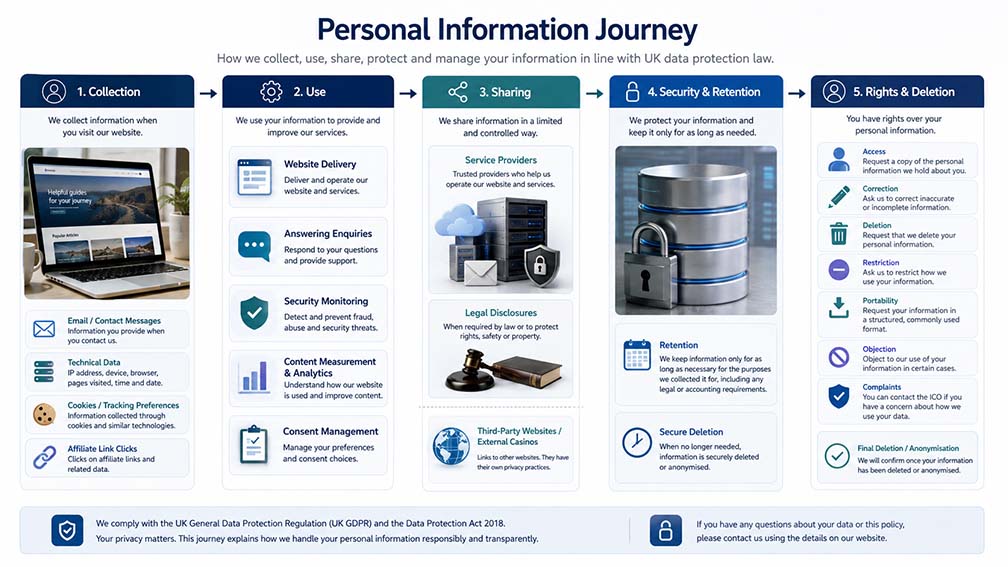
Scope and Website Identity
This privacy notice applies to information processed in connection with browsing NonGamStop Casino Sites, contacting the website, following outbound links and using any consent controls displayed during a visit. It does not govern account registration, deposits, withdrawals, identity verification, gameplay or support interactions completed on another organisation’s platform. Personal data Information relating to an identified or identifiable individual. Processing Any operation involving personal information, including collection, storage, use, disclosure, correction or deletion. Controller The person or organisation deciding why and how information is processed. Processor A service provider handling information on a controller’s instructions. Cookie A small data file stored or accessed through a browser or device. Visitor Any person accessing, reading or communicating through the website.
UK privacy information should be concise, transparent, accessible and written in clear language. It should also explain processing purposes, retention arrangements and recipient categories.
Who This Policy Covers
This website privacy information applies to people who access published pages, communicate through the listed email address or interact with website features. Coverage depends on the activity taking place rather than a visitor’s nationality alone.
- Readers are covered when technical information accompanies a request for website content.
- Correspondents are covered when they send names, email addresses, message contents or supporting information.
- Visitors using consent controls are covered where preference records are associated with a browser or device.
- People leaving the website are subject to the receiving platform’s separate terms and privacy arrangements after redirection.
This policy does not establish responsibility for personal information collected directly by a casino, affiliate network, payment provider, identity-check service or advertising platform acting for its own purposes.
Controller and Contact Information
Responsibility for decisions concerning the processing described in this policy rests with the operator of NonGamStop Casino Sites. The website name identifies the publishing service and must not be interpreted as a separate incorporated company name.
| Detail | Published information | Purpose |
|---|---|---|
| Website | NonGamStop Casino Sites | Identifies the service covered by this policy. |
| Website address | https://nongamstopcasinosites.co.uk/ | Defines the principal domain within scope. |
| Privacy contact | [email protected] | Receives privacy questions, correction reports and rights requests. |
No individual should send identity documents, bank details, payment-card information, casino passwords or gambling-account credentials through the general contact address unless a secure and proportionate verification process has first been explained.
Personal Data Collection and Sources
Personal data enters the website environment through direct communication, ordinary web requests and optional technologies connected with measurement or affiliate attribution. The categories involved depend on the visitor’s actions and the tools active during a particular session.
| Category | Collection route | Typical purpose |
|---|---|---|
| Contact details | Email messages sent by a visitor | Responding to questions or requests |
| Communication content | Text and attachments supplied voluntarily | Understanding and resolving the matter raised |
| Technical records | Browser, server and security requests | Delivering pages and protecting website availability |
| Usage information | Page interactions where measurement tools operate | Understanding content performance |
| Preference records | Cookie or tracking selections | Remembering consent decisions |
| Referral information | Outbound-link or campaign parameters | Recording affiliate attribution where enabled |
Information You Provide Directly
Contact information is collected when a visitor emails [email protected]. The contents depend on what the sender chooses to provide. Details should remain relevant to the question, complaint, correction or request.
- Identity details. A message might include a name or preferred form of address.
- Contact details. An email address accompanies an ordinary email and enables a reply.
- Message contents. The written request supplies context needed to understand the issue.
- Supporting material. A sender might attach screenshots or documents relevant to a correction or privacy request.
- Preference information. A person might describe communication or consent choices requiring attention.
Free-text fields often allow unnecessary details to be disclosed. Messages should exclude casino passwords, complete payment information, identity documents, source-of-funds records and sensitive medical details unless the information is essential, requested through a secure process and proportionate to the issue.
Technical Data and Collection Sources
A normal website request contains technical information needed to deliver a page between a server and a browser. Relevant fields often include an IP address, requested path, date, time, browser information, operating system data and referring address. Security services also generate records when they identify errors, unusual traffic or attempted misuse.
Where analytics, consent management or affiliate attribution operates, further identifiers or interaction details might accompany the request. Optional technologies should remain distinct from records needed to provide, secure or remember essential website functions.
| Data type | Source | Use |
|---|---|---|
| IP address | Network request | Page delivery, security and diagnostics |
| Request time | Server record | Error review and traffic analysis |
| Browser details | User agent information | Compatibility and fault investigation |
| Requested page | Web request | Content delivery and aggregate measurement |
| Referring address | Browser request | Understanding navigation sources |
| Consent selection | Preference interface | Applying the visitor’s tracking choices |
| Referral identifier | Outbound affiliate link | Attribution of a qualifying referral |
Technical identifiers do not automatically become anonymous merely because a person’s name is absent. Identifiability depends on the information available and the realistic means of linking it to an individual.
Purposes and Lawful Bases
Each use of personal information requires a lawful basis suited to its purpose. Consent is not the only lawful ground. Current UK guidance identifies seven bases, including consent, contract, legal obligation, vital interests, public task, recognised legitimate interest and legitimate interests.
| Purpose | Information involved | Relevant basis |
|---|---|---|
| Delivering website pages | Network and request information | Legitimate interests in operating an accessible website |
| Protecting systems | Security logs and technical events | Legitimate interests in preventing misuse |
| Answering correspondence | Contact details and message content | Legitimate interests or steps requested by the sender |
| Remembering tracking choices | Consent and browser identifiers | Legal obligation or legitimate interests linked to preference records |
| Optional analytics or advertising | Usage and referral information | Consent where required for the relevant technology |
| Handling legal matters | Relevant correspondence and records | Legal obligation or legitimate interests |
Legitimate interests requires consideration of purpose, necessity and the effect on the individual. A commercial benefit alone does not remove the need to protect people’s rights and reasonable expectations.
How Personal Data Is Used
Data processing connected with the website is limited to purposes relevant to publishing, communication, technical operation, preference management and lawful administration.
- Deliver requested pages and maintain compatibility across browsers and devices.
- Respond to correspondence sent through the published contact address.
- Investigate errors, malicious traffic, unauthorised access attempts and service disruption.
- Assess aggregate use of articles and navigation where permitted measurement tools operate.
- Record consent choices so optional technologies follow the selected preferences.
- Preserve information needed to establish, exercise or defend legal rights.
Information collected for one purpose is not automatically suitable for another. A materially different use requires a fresh assessment of necessity, fairness, transparency and lawful basis before processing begins.
Affiliate Advertising and Communications
NonGamStop Casino Sites publishes affiliate content. Some outbound links include referral information used to record traffic sent to another website. A receiving platform might place its own technologies, obtain technical details and process registration or transaction information under a separate policy.
Clicking an affiliate link does not give NonGamStop Casino Sites control over the receiving organisation’s account, verification, payment or gambling records. Visitors should inspect the destination address and privacy information before submitting details.
- Affiliate attribution. A link might contain an identifier connecting a visit with a publisher or campaign.
- Advertising measurement. Optional tools require the appropriate visitor choice where consent rules apply.
- Email communication. Replies to direct enquiries concern the subject raised by the sender.
- Preference withdrawal. Consent for optional processing is withdrawn through the relevant control or contact route.
Promotional messages require a proper legal basis and an accessible unsubscribe method. An unsubscribe record might remain on a suppression list so the preference is respected.
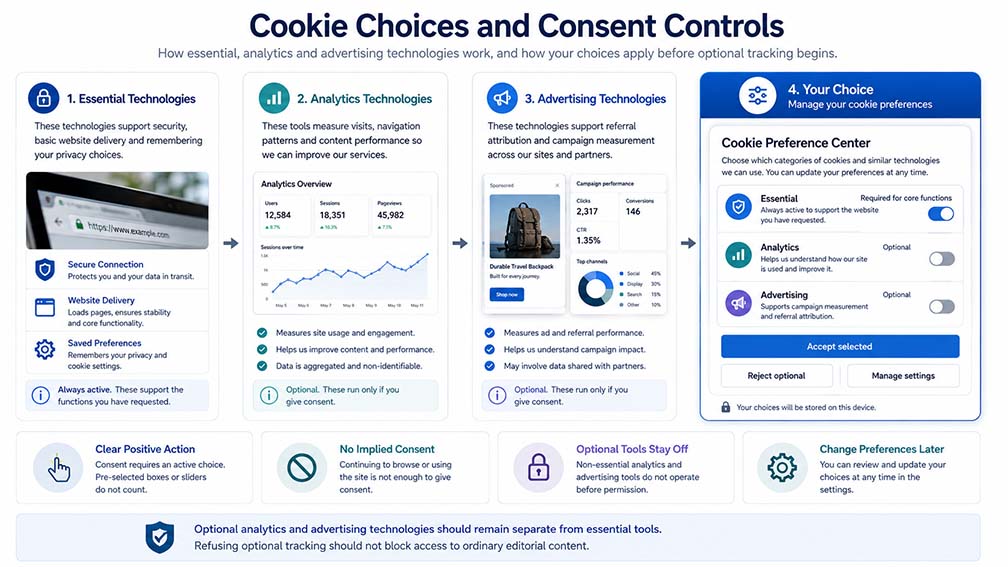
This cookie policy section covers browser files, local storage, pixels, tags and related technologies. Essential tools support functions such as security, network delivery and remembering a privacy choice. Optional analytics or advertising technologies require the level of permission set by applicable law.
Valid consent requires a clear positive action. Continuing to browse is not enough by itself, and non-essential cookies should not be placed before the required permission has been obtained.
Cookie Types and Purposes
Tracking technologies are grouped by function. The active inventory depends on the services operating on the website at the time of a visit. A browser’s developer tools and any displayed consent interface provide further device-level information.
| Technology category | Purpose | Visitor control |
|---|---|---|
| Essential | Supports security, delivery and basic preference functions | Operates where necessary for the requested service |
| Functional | Remembers optional interface or browser choices | Managed through available preference settings |
| Analytics | Measures visits, navigation and content performance | Enabled only under the applicable consent setting |
| Advertising | Supports referral attribution or campaign measurement | Enabled only under the applicable consent setting |
Duration differs between a session technology, which ordinarily ends after a browser session, and a persistent identifier, which remains until its configured expiry or earlier deletion. Removing browser storage does not erase information already lawfully recorded in server, consent or affiliate systems.
Consent and Preference Management
Cookie consent should remain specific, informed and freely given. Visitors need a meaningful choice between optional categories and an accessible route for changing a previous decision.
- Open the privacy or cookie settings control displayed by the website.
- Review the purpose of each optional category before selecting a preference.
- Save the selection so the website applies the chosen settings.
- Return to the control to withdraw or revise permission at a later point.
Browser settings also support deletion or blocking of stored files. Blocking every technology might affect remembered choices or other functions relying on local storage. A refusal of optional analytics or advertising should not prevent access to ordinary editorial content.
Information is shared only where access supports a defined processing purpose, a lawful instruction or a legal requirement. Recipient roles differ. Some providers act on instructions, while another organisation might determine its own purposes and operate as a separate controller.
Access from outside the United Kingdom requires an assessment of whether the arrangement forms a restricted transfer and which protection applies. Current UK rules recognise adequacy regulations, appropriate safeguards and limited exceptions as transfer mechanisms.
Recipients and Legal Disclosures
Service providers receive only the information needed for the relevant function. The exact organisations involved depend on the website’s hosting, security, communication, measurement and affiliate arrangements.
| Recipient category | Information shared | Reason |
|---|---|---|
| Hosting and network providers | Requests, logs and technical identifiers | Delivering pages and maintaining availability |
| Security services | Network events and suspected misuse indicators | Detecting threats and protecting systems |
| Email providers | Sender details and message contents | Receiving, storing and delivering correspondence |
| Consent or analytics providers | Preferences and usage information | Applying choices and measuring content where enabled |
| Affiliate platforms | Referral identifiers and technical click data | Recording outbound referrals |
| Professional advisers | Information relevant to a dispute or obligation | Obtaining legal, accounting or compliance assistance |
| Public authorities | Information required by a valid legal demand | Meeting an enforceable statutory obligation |
Disclosure is not permitted merely because a party requests information. The request must have an appropriate basis, and the information supplied should remain relevant and proportionate.
Overseas Processing and Safeguards
International transfers arise where personal information is sent or made accessible to a separate organisation outside the United Kingdom in circumstances governed by UK transfer rules. The protection depends on the destination, recipient role and legal mechanism.
| Transfer route | Legal basis | Protection |
|---|---|---|
| Destination covered by UK adequacy rules | Applicable adequacy regulation | Government assessment of the destination’s protection |
| Destination without adequacy coverage | Approved contractual or other safeguard | Transfer assessment and supplementary steps where needed |
| Exceptional restricted transfer | Narrow statutory exception | Necessity and proportionality assessment |
An appropriate safeguard might involve the UK International Data Transfer Agreement, the UK Addendum or another approved mechanism. A transfer assessment considers whether protection in the destination remains sufficiently effective.
Security and Data Retention
Data security requires safeguards proportionate to the information, processing purpose and likely harm arising from loss or misuse. Internet transmission always involves residual risk, so visitors should avoid placing unnecessary sensitive information in ordinary emails.
Retention should last no longer than required for the relevant purpose, subject to legal duties, dispute handling, security needs and documented deletion arrangements. Different records require different periods and triggers.
Protection and Incident Response
Security measures should reduce unauthorised access, accidental loss, alteration, disclosure and service disruption without exposing configurations in a way which weakens protection.
- Access control. Personal information should remain accessible only to people or providers requiring it for an authorised function.
- Transmission protection. Website and communication services should use appropriate safeguards while information travels across networks.
- Storage protection. Accounts, systems and backups should apply proportionate authentication and permission controls.
- Monitoring. Technical events should be reviewed where they indicate faults, abuse or unauthorised activity.
- Incident handling. Suspected loss or misuse should be contained, assessed, documented and escalated where notification duties arise.
Privacy or security concerns relating to NonGamStop Casino Sites should be reported to [email protected]. The message should identify the affected page, approximate time and nature of the concern without including unnecessary confidential material.
Retention Periods and Deletion
Data retention follows purpose-based criteria rather than one period for every record. A record is deleted or anonymised when its operational, legal and security purpose ends, unless continued storage has another valid basis.
| Data category | Retention rule | End action |
|---|---|---|
| Contact correspondence | Kept while the enquiry, request or related issue remains active | Deletion or restricted archival storage |
| Technical logs | Kept for security, diagnostics and operational review | Automatic deletion or aggregation |
| Consent records | Kept while needed to demonstrate and apply the recorded choice | Replacement, expiry or deletion |
| Affiliate referral records | Kept for attribution, reconciliation and dispute handling | Deletion or aggregation after the relevant period |
| Legal records | Kept while required for an obligation or legal claim | Secure deletion after the applicable period |
Backup systems often remove information through scheduled replacement rather than immediate record-level deletion. Access to retained backups should remain restricted, and restored data should return to the applicable deletion process.
Your Rights and Complaints
Data protection rights give individuals control over information concerning them. The right available in a particular case depends on the processing purpose, lawful basis and any applicable exemption. Requests should be sent to [email protected] with enough detail to identify the relevant information.
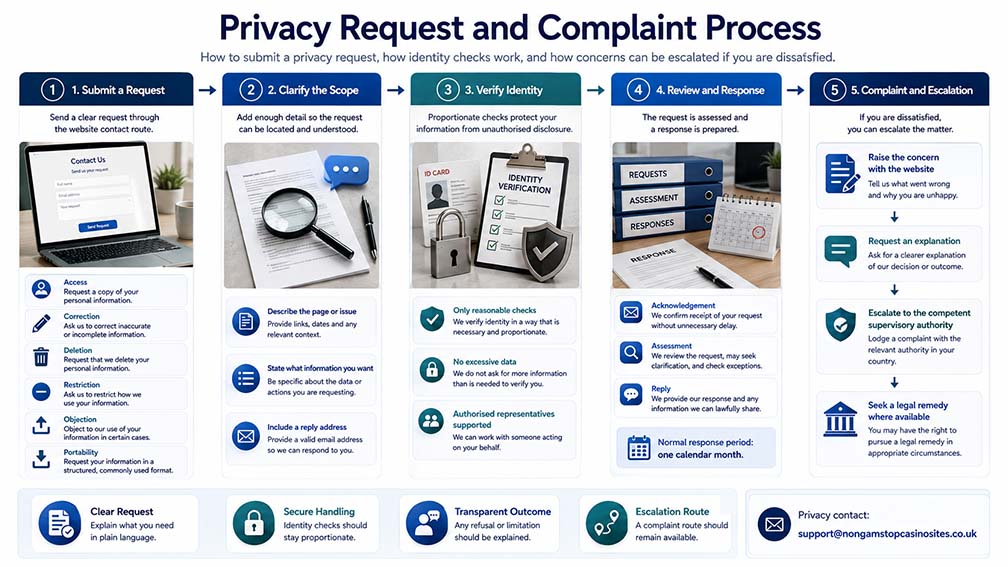
Rights Requests and Identity Checks
Access You are entitled to ask whether personal information concerning you is processed and to request a copy where the right applies. Rectification You are entitled to request correction of inaccurate information or completion of an incomplete record. Erasure You are entitled to request deletion in circumstances where no overriding lawful reason requires continued processing. Restriction You are entitled to request limited use of information while certain accuracy, objection or legal issues are considered. Portability You are entitled to request eligible information in a structured, commonly used and machine-readable format where the statutory conditions apply. Objection You are entitled to object to processing based on particular grounds, including certain uses relying on legitimate interests. Automated decisions You have protections relating to qualifying decisions based solely on automated processing which produce legal or similarly significant effects.
A request does not require legal terminology. It should describe the information or activity involved and provide a reliable reply address. Additional identity evidence should be requested only where reasonable doubts exist and only to the extent needed to protect information from unauthorised disclosure.
The right to rectification includes inaccurate or incomplete personal information, and a controller ordinarily has one calendar month to respond.
Response Timing and Regulatory Complaints
- Acknowledgement. The request is identified and recorded through the published contact route.
- Clarification. Further detail is sought where the scope remains unclear or the relevant information cannot be located.
- Verification. Proportionate checks protect personal information from disclosure to the wrong person.
- Response. The outcome, information supplied and any applicable limitation are explained in clear language.
- Escalation. A dissatisfied person retains the right to raise the matter with the competent supervisory authority and seek a legal remedy.
A valid rights request should normally receive a response without undue delay and within one calendar month. A longer period applies only where current law permits an extension, and the requester should receive an explanation within the initial period.
Where a request is refused or limited, the response should explain the reason where disclosure of the explanation remains lawful. It should also identify available complaint and enforcement routes.
Children and Linked Casino Websites
Gambling-related content is intended for adults, but an adult subject does not by itself prove children never access a website. Online services likely to be accessed by children require a documented assessment of child-data risks and age-appropriate safeguards.
External casino websites control their own age checks, accounts, verification processes, gambling records and payment information. Their privacy terms apply after a visitor enters the external service.
Age Restrictions and Child Data
Age restrictions linked to gambling do not replace privacy safeguards. The UK Children’s Code applies to information society services likely to be accessed by children, including services not expressly directed at them. It sets 15 standards for protecting children’s information online.
- Intended audience. Casino reviews and gambling guidance are directed towards adults legally permitted to gamble.
- Accidental disclosure. A child or guardian should report suspected submission of a child’s information through the published email address.
- Data minimisation. Correspondence should include only the details needed to identify and resolve the concern.
- Protective handling. Information identified as belonging to a child requires prompt assessment, restricted access and deletion where no lawful reason supports retention.
Services within the Children’s Code should place the child’s best interests first, use high-privacy defaults and minimise collection and retention.
External Casino Privacy Practices
Third party websites reached through casino links operate outside this policy. Before creating an account or submitting identification, payment or gambling information, visitors should review the destination’s own disclosures.
- Check the legal operator identity and privacy contact information.
- Read which account, payment, device, verification and gambling records are collected.
- Review purposes, lawful bases, marketing choices and profiling explanations.
- Inspect retention periods, international transfers and recipient categories.
- Confirm rights procedures, complaint routes and security guidance before sending sensitive documents.
An affiliate link is not proof of shared ownership, shared systems or identical privacy standards. NonGamStop Casino Sites does not administer an external operator’s account closure, data access, deletion, payment dispute or self-exclusion procedure.
Policy Updates and Contact
This policy should be reviewed when website features, service providers, tracking technologies, legal requirements or processing purposes change. A material new use of personal information should be brought to affected individuals’ attention before the new processing starts.
The current version should display its effective date as September 2026. Visitors should revisit this page periodically, particularly after a notice appears concerning revised privacy or cookie arrangements.
- Privacy requests. Send access, correction, deletion, restriction, objection or portability requests to [email protected].
- Policy corrections. Report inaccurate wording, broken controls or inconsistencies through the same address.
- Technical concerns. Include the affected page, approximate time, browser context and a concise description without exposing passwords or payment details.