How We Review Online Casinos
NonGamStop Casino Sites assesses online casinos through a structured editorial framework built around identity, licensing, account rules, payments, promotions, games, player protection, complaints, and material risk. The aim is practical comparison for UK adults. Each review separates confirmed terms from promotional language, distinguishes Great Britain licensing from offshore authorisation, and avoids promises about safety, payouts, winnings, or dispute outcomes.
Casino conditions change. Readers should check current eligibility, legal status, payment rules, bonus restrictions, and safer gambling controls before opening an account. Our approach focuses on information which affects access to funds, personal data, account closure, self-exclusion, and external redress.
- Identify the legal operator and relevant licence.
- Check registration, KYC, AML, and territory rules.
- Compare deposit methods, fees, limits, and payout stages.
- Read bonus conditions beyond the headline offer.
- Assess games, suppliers, RTP information, and mobile access.
- Review safer gambling tools, support, complaints, and closure terms.

The framework also records uncertainty. Where an operator omits a material figure or publishes conflicting conditions, the review avoids favourable assumptions and explains the practical consequence for your decision.
Review Methodology and Editorial Scope
This Review Methodology explains the subjects covered when NonGamStop Casino Sites publishes casino reviews and related affiliate information. The framework centres on consumer relevance, measurable conditions, clear risk wording, and separation between factual findings and editorial judgement.
| Review area | Core check | Reader value |
|---|---|---|
| Identity | Operator, licence holder, and domain relationship | Shows who controls the service |
| Accounts | Eligibility, registration, KYC, and restrictions | Clarifies access requirements |
| Payments | Methods, charges, limits, and payout stages | Reveals financial conditions |
| Promotions | Wagering, expiry, caps, and exclusions | Shows practical bonus value |
| Platform | Games, suppliers, RTP, and device access | Explains product scope |
| Protection | Limits, exclusion, complaints, and closure | Highlights safeguards and gaps |
Each subject receives separate treatment so a positive feature does not conceal a restrictive financial or contractual term.
Reader Purpose and Website Role
NonGamStop Casino Sites is an affiliate website publishing online casino reviews and related information. Its content supports UK adults comparing legal identity, account rules, payment terms, promotional restrictions, safer gambling controls, and complaint options. A review helps organise these points, but the final decision remains yours.
Before registration, complete four checks:
- Match the casino domain with its named operator and licence record.
- Read current terms for age, residence, verification, and restricted territories.
- Set an affordable spending limit before depositing money.
- Confirm self-exclusion status and available blocking tools.
The website does not replace operator terms, regulatory records, personal affordability controls, or independent advice.
Review Coverage and Core Criteria
Our online casino criteria group related rules so readers see the full account relationship rather than isolated selling points.
- Legal control: brand, operator, licence holder, approved domain, and ownership links.
- Account access: age, residence, duplicate accounts, registration, login, KYC, AML, and source-of-funds checks.
- Money movement: deposits, withdrawals, currencies, crypto assets, fees, minimums, maximums, and processing stages.
- Promotions: qualifying deposits, wagering bases, maximum bets, expiry, excluded games, contribution rates, and cashout ceilings.
- Casino product: game categories, software suppliers, RTP information, rules, live tables, and restricted titles.
- Platform access: browser use, apps, navigation, search, filters, language, currency, and account functions.
- Player protection: limits, reality checks, timeouts, self-exclusion, marketing controls, and account history.
- Disputes and closure: support routes, complaints, ADR, dormancy, refunds, suspended accounts, and fund handling.
These groups support consistent comparisons while keeping jurisdiction-specific duties separate.
Boundaries and Unsupported Claims
Editorial limitations matter because casino reviews often contain claims which exceed available proof. NonGamStop Casino Sites does not present private deposits, gameplay, KYC submissions, support chats, withdrawal requests, RNG audits, or confidential operator records as completed work without documented results.
The following statements require direct proof before publication:
- Named staff, qualifications, awards, memberships, or years of experience.
- Testing volumes, deposited sums, devices, response times, or payout results.
- Commercial contracts, commission rates, regulator relationships, or provider partnerships.
- Guaranteed accuracy, guaranteed payment, or universal casino suitability.
- Claims of independence unsupported by an approved commercial policy.
You should still verify current terms, assess affordability, protect login details, keep transaction records, and seek suitable professional advice where a dispute involves significant money or legal rights.
Evidence Standards and Fact Verification
Casino fact verification starts with the record closest to the claim. A licence status belongs in a regulator register. Account restrictions belong in contractual terms. Bonus limits require complete promotion rules. Payment figures need method-specific cashier details. Secondary reviews, forums, and social posts provide context, but repetition never proves accuracy.
- Capture the exact claim, unit, scope, currency, and effective period.
- Locate the primary record linked to the relevant operator or authority.
- Compare entity names, domains, dates, limits, and jurisdiction.
- Record conflicts without merging incompatible values.
- Use cautious wording or omit unresolved figures.

Dates receive equal attention because an accurate figure from an expired promotion still misleads a reader. A valid finding also needs the correct territory, product, payment method, account status, and currency. Where scope remains unclear, wording stays limited rather than extending a rule beyond its stated application.
Source Priority and Verification Steps
A source verification process should preserve the detail attached to every figure. A £20 minimum deposit differs from a £20 minimum withdrawal. Three business days differs from three calendar days. A monthly cashout cap differs from a maximum request value.
| Verification step | Required information | Editorial outcome |
|---|---|---|
| Identify | Brand, operator, domain, jurisdiction | Correct entity attribution |
| Locate | Applicable terms or public record | Primary basis selected |
| Match | Names, numbers, dates, and scope | Claim accepted or challenged |
| Compare | Conflicting values and effective periods | Newest applicable rule preferred |
| Qualify | Limits, exclusions, fees, and conditions | Material restrictions added |
| Publish | Neutral wording and reader action | Clear practical conclusion |
The same discipline applies to legal identity. A payment processor is not automatically the gambling operator, and a software licence does not automatically authorise consumer-facing casino activity. Each role needs its own matching record before a relationship receives firm wording.
Conflicts Gaps and Change Records
Casino information conflicts often arise when a promotional banner, general terms, cashier screen, and bonus policy show different values. The rule applying directly to the transaction, account, territory, or offer receives priority. A newer effective date also matters where older wording remains accessible.
Unresolved numerical differences should not be averaged or combined. Missing publication never means a zero fee, unlimited withdrawal, unrestricted access, or favourable condition.
- Conflicting payment limits require method-level treatment.
- Expired offers require removal from current bonus descriptions.
- Broken licence links require a fresh register check.
- Mismatched operator names require cautious ownership wording.
Material omissions also affect presentation. If a casino publishes a withdrawal maximum without frequency, the figure should not appear as a daily, weekly, or monthly allowance. If two policies overlap, the stricter applicable condition needs prominent treatment until the conflict ends.
Licence Operator and Ownership Checks
Casino licence checks separate a marketing brand from the company responsible for gambling activity. The assessment follows the legal entity, licence holder, approved domain, permitted activity, current status, and published regulatory action. A footer badge alone offers insufficient proof.
- Record the exact casino domain.
- Identify the contractual operator.
- Match the licence holder with a public register.
- Check whether the domain appears under the relevant record.
- Confirm activity type and status.
- Review published sanctions, suspensions, or expiry information.
A UK Gambling Commission licence applies to gambling offered in Great Britain. Offshore authorisation follows another legal framework and should never receive equivalent treatment.
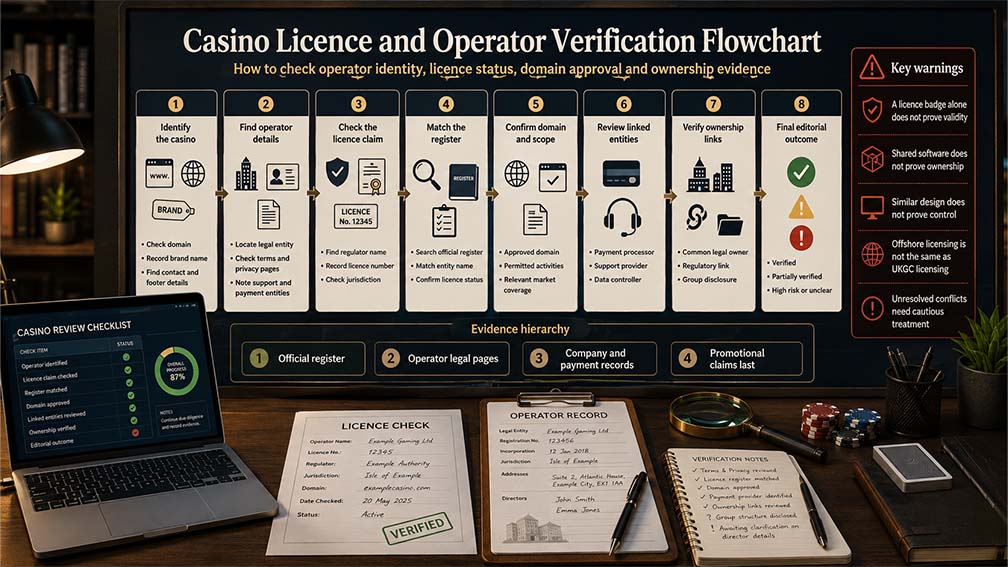
The review also distinguishes licence status from quality. Active authorisation identifies a regulatory relationship, yet it does not erase restrictive terms, payment concerns, complaints, or weak account controls. Expired, suspended, surrendered, or revoked entries require direct wording suited to the recorded status.
Readers should compare the recorded entity with every contractual page.
Licence Status and Register Matching
Licence register matching requires agreement across several fields. The UK Gambling Commission business register supports searches by business name, trading name, domain name, or account number. A record should identify the legal account holder and current licence status. Activity scope also matters because software, host, casino, betting, and other permissions serve different functions.
| Register field | Website claim | Required match |
|---|---|---|
| Status | Active authorisation | Current active entry |
| Entity | Named operator | Legal account holder |
| Domain | Casino web address | Relevant registered domain |
| Activity | Casino service | Applicable remote permission |
| Action | Clean regulatory position | Published enforcement reviewed |
A domain match deserves close attention because a valid company licence does not automatically cover every website using its name. Readers should also note whether the record permits remote casino activity and whether published action changes the risk assessment.
Expired or restricted permissions need precise status wording.
Operator Identity and Domain Links
Casino operator identity involves several roles. The brand faces the customer. The operator enters the gambling contract. A licence holder carries regulatory permission. A payment processor handles selected transactions. A data controller determines personal data use. A support provider answers service requests.
One company might fill several roles. Separate entities need precise attribution. Shared graphics, software, payment options, or service wording do not establish ownership.
Contracts and privacy documents should use consistent legal names. Unexplained changes between these pages increase uncertainty, especially where withdrawals, complaints, or data requests involve a different company.
Related Casinos and Ownership Proof
Casino ownership proof determines whether another brand belongs in a confirmed sister-site list, an operational-links section, or a simple alternatives comparison. Common suppliers, layouts, bonuses, support wording, or cashier design remain insufficient on their own.
| Evidence type | Classification result |
|---|---|
| Same incorporated owner | Confirmed corporate relationship |
| Same licensed operator | Confirmed operational relationship |
| Regulator links several trading names | Confirmed licence connection |
| Group company filing | Confirmed ownership chain |
| Explicit legal disclosure | Confirmed stated relationship |
| Shared game supplier | Similarity only |
| Matching promotion | Similarity only |
| Comparable website design | Similarity only |
Confirmed group links matter because shared account limits, complaint history, licence action, or payment policy sometimes affect several brands. Alternatives remain separate where legal control lacks proof.
Group membership should never rest on branding alone.
Accounts Payments and Withdrawal Rules
Casino payment rules affect eligibility, verification, funding, withdrawals, account closure, and access to balances. Reviews separate deposits from payouts, internal approval from provider transfer, fiat from cryptocurrency, ordinary limits from bonus restrictions, and pending requests from completed transactions.
- Check age, residence, accepted territories, and account ownership.
- Identify KYC, AML, payment ownership, and source-of-funds conditions.
- Record each deposit method, currency, minimum, maximum, and fee.
- Separate withdrawal request caps from daily, weekly, or monthly limits.
- Distinguish internal processing periods from bank or wallet delivery.
- Review reversal, dormancy, closure, and remaining-balance rules.
Financial wording should preserve exact scope. A £1,000 request limit is not a £1,000 monthly allowance. A three working day internal review does not include weekend handling or the later transfer period. Crypto deposits also require the correct asset and network, since an address mismatch risks permanent loss.
Every restriction belongs beside the figure it qualifies.
Eligibility Registration and Verification Checks
Casino verification checks start before money enters an account. For UK Gambling Commission licensed remote operators, age verification must occur before a customer deposits, accesses free-play gambling, or wagers. Identity checks require at least the name, address, and date of birth before gambling starts.
Further requests might arise from fraud prevention, anti-money laundering duties, payment ownership concerns, or source-of-funds review. A withdrawal request should not trigger information which the operator reasonably should have requested earlier, although later legal obligations still apply.
- Minimum age and accepted residence.
- Identity and date-of-birth details.
- Address confirmation.
- Payment method ownership.
- Source-of-funds information.
- Duplicate-account restrictions.
- Consequences of failed checks.
Reviews should also identify whether registration creates one account across casino, sportsbook, bingo, or other products. Territory restrictions, VPN clauses, sanctions rules, and payment-country mismatches affect eligibility even after successful sign-up.
Successful registration does not guarantee continued eligibility.
Deposit Methods Fees and Limits
Casino deposit methods require method-level treatment. Card, bank transfer, e-wallet, voucher, and cryptocurrency options differ in ownership rules, currencies, transaction minimums, maximums, funding charges, processing descriptions, and bonus eligibility.
| Payment method | Key condition | Reader consideration |
|---|---|---|
| Card | Name matching and issuer acceptance | Check currency conversion and bank blocks |
| Bank transfer | Account ownership and reference details | Review transfer period and charges |
| E-wallet | Supported provider and verified account | Check bonus exclusions |
| Voucher | Deposit-only funding | Identify available payout route |
| Cryptocurrency | Network, wallet, asset, and confirmation rules | Review volatility and irreversible transfers |
Every amount needs a currency and scope. A per-transaction limit differs from a daily or monthly ceiling. A percentage charge differs from a fixed fee.
Funding availability often differs by residence, device, currency, and account history. Reviews should avoid presenting one visible option as universally available. Deposit acceptance also does not prove the same route supports withdrawals.
Withdrawal Times Limits and Conditions
Casino withdrawal times involve several stages. A request enters a pending period, moves through account and payment review, receives approval, leaves the operator, then travels through a bank, wallet, card network, or blockchain. One advertised period rarely covers every step.
| Payout stage | Verified period | Reader risk |
|---|---|---|
| Pending | Operator-defined review window | Cancellation or reversal access |
| Verification | Document-dependent period | Delayed approval |
| Approval | Internal processing window | Account or bonus restrictions |
| Transfer | Method-specific delivery estimate | Provider delay or rejection |
| Receipt | Completed account credit | Currency or intermediary charges |
Reviews also examine maximum request values, transaction frequency, monthly cashout caps, fees, bonus withdrawal ceilings, weekend treatment, dormant-account effects, and document holds. No payout date receives a guarantee.
A clear review should identify whether the operator permits several open requests, applies a minimum payout, limits withdrawal frequency, or returns funds through the original deposit route. Where cryptocurrency is involved, network confirmations and wallet ownership deserve separate treatment. Chargeback clauses should appear beside related suspension or forfeiture risks.
Bonus Games and Fairness Criteria
Casino bonus review separates promotional size from practical value. A percentage match means little without the qualifying deposit, wagering base, maximum bet, expiry, contribution schedule, excluded games, free-spin value, cashout ceiling, and forfeiture rules.
- Check eligibility, minimum deposit, and promotional period.
- Identify wagering calculations and game contribution.
- Record maximum bets, withdrawal caps, and expiry.
- Review bonus abuse and irregular-play wording.
- Confirm game suppliers, categories, and rules.
- Check RTP information and integrity records.
- Separate lobby size from product quality.
- Assess browser, mobile, and account access.
| Criterion | Required check | Material risk |
|---|---|---|
| Wagering | Rate and calculation base | Higher required turnover |
| Maximum bet | Per-spin or per-round cap | Bonus forfeiture |
| Expiry | Claim and completion period | Unused value removed |
| Cashout | Maximum withdrawable amount | Winnings restricted |
| Providers | Supplier identity and title access | Unavailable or restricted games |
| RTP | Game-specific return information | Misleading expectations |
Bonus Value Terms and Restrictions
Bonus terms and restrictions need a full calculation. Suppose an offer gives £20 in bonus funds with 10 times wagering on the bonus. The required turnover equals £200 before associated funds become withdrawable, subject to game contribution, maximum-bet rules, expiry, and other conditions.
For UK Gambling Commission licensed operators, promotional wagering on bonus funds must not exceed 10 times. Incentives must not combine more than one gambling product, such as casino and betting, within a single offer. These requirements took effect on 19 January 2026.
| Bonus condition | Verified rule | Practical effect |
|---|---|---|
| Qualifying deposit | Minimum amount and method | Controls entry |
| Wagering | Rate and applicable funds | Sets required turnover |
| Maximum bet | Per round or spin | Limits stake size |
| Expiry | Claim and playthrough deadline | Shortens completion time |
| Excluded games | Zero or reduced contribution | Restricts eligible play |
| Cashout | Withdrawal ceiling | Caps realised value |
Offshore promotions follow their own published rules and regulator framework. A larger percentage, longer playthrough, or higher headline cap does not establish better value. Readers should compare the amount realistically withdrawable after every restriction rather than focus on the advertised maximum.
Games Providers RTP and Integrity
Casino game integrity involves more than a large lobby. Reviews identify software suppliers, game categories, original rules, regional access, bonus contribution, RTP disclosure, RNG information, live-casino provision, and recognised testing records where published.
RTP represents a long-term theoretical return across extensive play. It does not predict one session, protect a balance, or promise a result. The same title sometimes appears with different RTP settings, so game-level information matters more than a provider-wide assumption.
- Match each supplier with genuine titles.
- Read rules before staking money.
- Check game-specific RTP information.
- Review RNG or testing details where relevant.
- Confirm regional and device access.
- Identify bonus contribution and excluded categories.
Game counts also require a consistent method. Category totals, duplicate mobile versions, unavailable regional titles, and live-table variants should not inflate a comparison. Reviews should note whether rules and paytables open before play and whether supplier names match genuine products.
Mobile Access and Platform Quality
Mobile casino quality depends on essential functions rather than visual polish. A useful assessment covers account creation, login, verification uploads, deposits, withdrawals, game search, filters, safer gambling controls, support access, language, currency, and location restrictions.
- Open the site on supported mobile browsers.
- Check navigation across portrait and horizontal views.
- Locate account, cashier, and verification controls.
- Test game search and category filters.
- Review responsible gambling settings.
- Confirm support access without leaving the account area.
- Identify app requirements or browser-only access.
Claims about speed, stability, loading, or optimisation require recorded device and network measurements. Published compatibility details receive neutral treatment where first-hand results do not exist.
Accessibility deserves attention as well. Text size, contrast, keyboard access, error messages, and document-upload clarity affect account management, especially during verification or payment problems.
Support and Player Rights Assessment
Casino player rights extend beyond access to live chat. Reviews examine contact routes, operating hours, help-centre coverage, complaint escalation, voluntary closure, suspension, dormancy, refunds, bonus forfeiture, remaining balances, and reopening rules.
| Policy point | Reader action |
|---|---|
| Contact channels | Save the relevant address or form |
| Service hours | Check timezone and availability |
| Complaint route | Follow stages in order |
| Closure request | Keep written confirmation |
| Dormancy | Record inactivity period and fees |
| Suspension | Ask for reason and required action |
| Refunds | Check eligibility and payment route |
| Remaining balance | Confirm withdrawal conditions |
Account terms deserve priority where marketing claims conflict with closure or balance rules. Readers should retain emails, chat transcripts, case numbers, and transaction records because later escalation often depends on a clear timeline. The website contact address never replaces the operator complaint channel.
Clear records strengthen later complaints and payment queries.
Support Channels and Service Information
Casino support channels should be easy to locate before registration. Relevant options include live chat, email, telephone, web forms, help centres, and complaint addresses. Service availability, language coverage, account access requirements, and escalation routes deserve separate treatment.
- Channel: identify each published contact method.
- Hours: record operating times and timezone.
- Language: note available written and spoken support.
- Access: check whether login is required.
- Self-service: review payment, KYC, bonus, and closure articles.
- Escalation: locate complaint and external dispute routes.
A chatbot differs from a human adviser. Response speed or service quality requires time-stamped contact records, so promotional claims receive cautious wording without such results.
A useful help centre should explain verification, transaction states, bonus restrictions, safer gambling controls, and closure steps without requiring repeated contact. Missing escalation information increases practical friction.
Account Closure Dormancy and Refunds
Casino account closure covers several events with different fund effects. A voluntary request differs from self-exclusion, regulatory restriction, fraud review, commercial suspension, dormancy, or operator shutdown.
| Account event | Verified rule | Fund effect |
|---|---|---|
| Voluntary closure | Request method and confirmation | Balance withdrawal process |
| Self-exclusion | Duration and access restriction | Withdrawable funds handled separately |
| Suspension | Reason and review procedure | Temporary access restriction |
| Dormancy | Inactivity period and charge | Balance reduction risk |
| Refund | Eligibility and destination method | Return subject to checks |
| Shutdown | Closure notice and claims route | Recovery depends on arrangements |
Reviews identify inactivity periods, fee frequency, verification before return, bonus forfeiture, reactivation terms, and treatment of small balances. Funds are neither universally refunded nor automatically forfeited.
Dormancy clauses need exact thresholds. A fee charged after 12 months differs from one applied monthly following an initial inactive period. Reviews should also identify notice requirements, balance exemptions, and any route for reclaiming residual funds.
Safer Gambling and Complaint Routes
Safer gambling standards influence editorial treatment because available controls, self-exclusion coverage, and external redress differ across jurisdictions. Reviews examine spending limits, time restrictions, reality checks, account history, marketing controls, complaint stages, ADR, and regulator scope.
- Deposit, spend, and loss limits.
- Daily, weekly, and monthly periods.
- Session controls and reality checks.
- Timeout durations and activation.
- Operator self-exclusion.
- Gamstop Online coverage.
- Complaint and ADR access.
- Offshore protection gaps.
No control removes every risk. Anyone already self-excluded should avoid offshore registration and use blocking, banking, and specialist support measures instead.
Jurisdiction matters throughout this assessment. Great Britain licensees follow UK Gambling Commission duties, while offshore operators follow foreign rules with different enforcement and consumer routes. A listed tool has limited value if activation is hidden, delayed, reversible without friction, or disconnected from related brands.
Reviews should also check whether controls apply across linked accounts, products, and related brands, since partial coverage leaves avoidable exposure.
Limits Timeouts and Self Exclusion
Casino self exclusion tools should cover both spending and access. For UK Gambling Commission licensed remote operators, timeout options include 24 hours, one week, one month, or another reasonable period up to six weeks. Financial-limit periods should include 24 hours, seven days, and one month.
| Control | What it changes | Review check |
|---|---|---|
| Deposit limit | Amount added | Period and reduction timing |
| Spend limit | Amount staked | Product and duration |
| Loss limit | Net loss amount | Calculation method |
| Reality check | Session awareness | Frequency and information shown |
| Timeout | Temporary account access | Available durations |
| Self-exclusion | Longer access block | Period and reopening rules |
| Marketing control | Promotional contact | Channel coverage |
| Account history | Spending visibility | Range and export options |
Limit increases deserve close review because protective value depends on timing and friction. Immediate reductions support harm control, while later increases should involve a delay. Simultaneous limits also need clear priority where daily, weekly, and monthly ceilings overlap.
Availability alone does not prove effective enforcement.
Gamstop Coverage and Offshore Risks
Casinos outside Gamstop sit beyond the scheme used by online gambling companies licensed in Great Britain. Gamstop Online is available to UK residents and blocks access to participating Great Britain licensed websites and apps. Current minimum periods are six months, one year, five years, or five years with auto-renewal.
| Protection area | Great Britain licence | Offshore position |
|---|---|---|
| Gamstop Online | Scheme participation required | Coverage usually absent |
| Regulator | UK Gambling Commission | Foreign authority or unclear status |
| Complaints | Internal process and eligible ADR | Jurisdiction-specific route |
| Promotion rules | British licence conditions apply | Foreign rules apply |
| Enforcement | British regulatory powers | Depends on offshore framework |
- Regulatory oversight differs.
- Dispute routes might offer weaker practical access.
- Operator identity might be harder to establish.
- Payment recovery often crosses jurisdictions.
- Self-exclusion enforcement might not follow Gamstop registration.
Registration with Gamstop Online does not automatically return withdrawable balances. Account holders should contact each relevant operator about remaining funds. The block might take up to 24 hours to become effective, so additional banking and device controls remain useful during the transition.
Complaints ADR and Escalation Paths
A casino complaint process should start with the operator. Keep account records, transaction references, promotion terms, emails, screenshots, identity requests, and dates. Write a clear description of the issue, requested resolution, and disputed amount.
- Gather account, payment, and communication records.
- Submit the complaint through the designated operator route.
- Follow each internal stage and retain acknowledgements.
- Request a final response or deadlock position where applicable.
- Use an eligible ADR provider under the relevant jurisdiction.
- Report regulatory concerns separately from a personal money claim.
For UK Gambling Commission licensed businesses, the full internal procedure should finish within eight weeks. The operator should provide written confirmation at the end of its process, or after eight weeks, together with ADR information where eligible. ADR does not guarantee recovery, and a regulator does not settle every individual payment dispute.
Complaint acknowledgements for Great Britain licensees should arrive as soon as reasonably possible and normally within three working days. Businesses offering round-the-clock gambling facilities should acknowledge within 24 hours. Keep the dispute focused, chronological, and supported by original records.
Ratings Recommendations and Exclusion Rules
Casino rating criteria should separate factual assessment, editorial verdict, list position, featured visibility, advertising, and affiliate links. A strong game lobby or large bonus never removes a serious licensing, ownership, payment, or player-protection concern.
| Evidence level | Editorial treatment | Reader meaning |
|---|---|---|
| Strong | Clear positive detail with conditions | Lower uncertainty in assessed area |
| Mixed | Balanced strengths and restrictions | Extra checks needed |
| Serious risk | Prominent warning and reduced recommendation | Material concern affects suitability |
| Exclusion | Removal from recommended placement | Risk exceeds acceptable threshold |
NonGamStop Casino Sites operates as an affiliate publisher. Commercial presentation should remain distinguishable from factual conclusions, while sponsored visibility needs clear labelling.
A transparent conclusion should explain which factors drove the result. Severe concerns receive priority over minor convenience features. Positive language should remain qualified where payment, licensing, ownership, or complaint information leaves unresolved uncertainty.
The same standard should apply across competing brands, regardless of promotional size, design quality, or commercial value.
Positive Evidence and Material Risks
Casino risk signals deserve more weight when they affect legal status, money, identity, personal data, exclusion, or dispute rights.
Positive indicators
- Verifiable licence status and matched domain.
- Clear operator and company identity.
- Accessible account and bonus terms.
- Precise payment fees, limits, and stages.
- Visible safer gambling controls.
- Usable complaint and escalation routes.
Material warnings
- Invalid, expired, or mismatched licence claims.
- Unclear ownership or contractual entity.
- Unexplained withdrawal restrictions.
- Conflicting maximum cashout rules.
- Broad forfeiture clauses.
- Weak self-exclusion enforcement.
- Missing complaint escalation.
- Unresolved regulatory action.
Popularity, review volume, social discussion, design quality, or supplier count never proves safe operation.
Risk severity depends on likely harm, financial exposure, scope, recency, and whether corrective action is visible. A single outdated banner differs from repeated contractual conflicts, while one resolved complaint differs from a broad payout restriction.
Prominent warnings should match the seriousness of the issue.
When Casinos Leave Recommendations
Casino exclusion rules should respond to material changes rather than preserve an outdated ranking. Licence suspension, domain mismatch, operator closure, serious payment complaints, misleading terms, security incidents, failed self-exclusion controls, unsupported promotions, or unclear ownership changes all require reassessment.
- Flag the issue and identify its effect on readers.
- Check the relevant legal, contractual, or transactional record.
- Classify severity, scope, recency, and remediation.
- Apply a warning, ranking reduction, suspension, or removal.
- Reassess only after meaningful corrective action.
Editorial wording should describe confirmed events and practical risk. Criminal accusations require authoritative proof and suitable legal review.
Removal does not always mean permanent exclusion. A casino might return after renewed authorisation, clear ownership disclosure, corrected terms, resolved payment controls, or stronger complaint access. Reinstatement should follow fresh assessment rather than promotional assurances.
Any return should explain the change which reduced earlier risk.
Ratings Rankings and Commercial Placement
Affiliate casino rankings need clear distinctions between editorial judgement and commercial presentation. A review result concerns assessed strengths, conditions, and risks. A recommendation reflects suitability within a defined comparison. Organic order reflects editorial relevance. Featured placement increases visibility. Advertising represents paid promotion. An affiliate link might generate revenue after a qualifying action.
| Page element | Editorial basis | Commercial disclosure |
|---|---|---|
| Review result | Criteria and material risks | No placement implication |
| Recommendation | Comparison suitability | Affiliate status disclosed |
| Organic order | Relevance and quality | Method explained |
| Featured position | Prominent display | Label where commercial |
| Advertisement | Paid visibility | Advertising label |
| Affiliate link | Tracked referral | Revenue relationship stated |
Readers should see commercial labels before selecting an offer. A paid position should never disguise a warning, remove material restrictions, or convert an unsupported claim into a factual statement. Affiliate status does not change the need for accurate operator identity and current terms.
Readers need enough context to separate prominence from quality.
Updates Corrections and Method Limits
Casino review updates matter after licence changes, ownership transfers, revised payment rules, expired promotions, altered withdrawal limits, complaint developments, or new regulatory duties. A visible correction route also helps readers report broken links and factual errors.
- Identify a scheduled or event-driven trigger.
- Recheck the affected claim and connected sections.
- Assess whether the change alters risk or recommendation.
- Revise factual wording, tables, and conclusions.
- Record material corrections with an appropriate date.
Reviews remain snapshots of published conditions. Readers should confirm live account terms before acting.
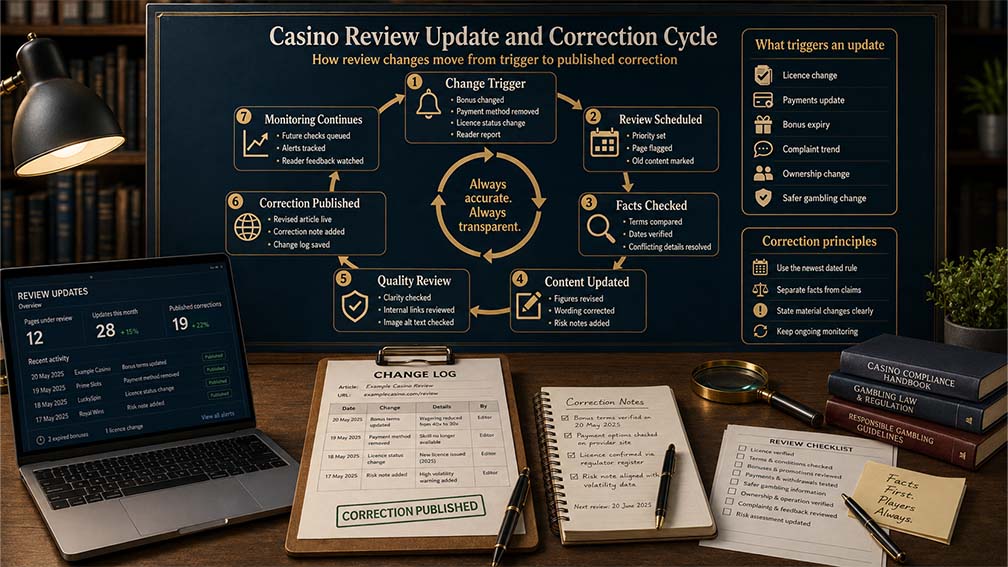
Minor edits differ from material revisions. Spelling changes do not need a new factual review date, while altered licence status, cashout limits, wagering rules, or complaint access require renewed assessment. Old comparisons should not survive where the underlying conditions changed.
A material change should reach every affected paragraph, table, warning, and FAQ answer.
Review Dates and Change Tracking
Review change tracking uses different dates for different purposes. Publication marks first release. A checked date records a later factual review. An effective date belongs to the operator rule or regulatory requirement. A corrected date marks a material amendment.
| Date type | What it records | Display rule |
|---|---|---|
| Published | Initial article release | Keep original date |
| Checked | Later factual review | Use only after completed checks |
| Effective | Rule start point | Attach to relevant condition |
| Corrected | Material content change | Explain significant revision |
Event-driven checks deserve priority after licence, ownership, payment, promotion, complaint, or regulatory changes. A fresh label should never replace a completed review.
The date closest to each claim gives the clearest context. A regulatory rule starting in September 2026 should not be presented as active earlier, while a withdrawn offer should not remain current after its end point.
Reader Corrections and Contact Route
To report a casino error, email [email protected]. Use the subject line Content correction and include enough detail for precise review.
- Provide the NonGamStop Casino Sites page URL.
- Quote the disputed statement.
- Explain the proposed correction.
- Attach a current legal, regulatory, or operator record.
- State the date when you observed the difference.
A correction request should focus on factual accuracy. Commercial pressure, preferred wording, or disagreement with a clearly labelled opinion does not by itself establish an error. Material amendments should update the affected conclusion where the revised fact changes reader risk.
Include original wording rather than a paraphrase where possible. Personal account disputes still belong with the casino, ADR provider, regulator, payment service, or suitable adviser. The editorial contact route handles content accuracy only.
Method Limitations and Reader Checks
Independent casino checks remain necessary because licences, account access, promotions, payments, and complaint routes change. A review organises relevant information at publication, but it does not guarantee future terms, operator conduct, payment receipt, account availability, or dispute success.
Before registering:
- Match the operator and domain with the current licence record.
- Confirm age, residence, and territory eligibility.
- Read complete account and bonus terms.
- Check payment fees, limits, and withdrawal stages.
- Set an affordable limit and protect personal data.
- Review self-exclusion status and complaint options.
Seek independent legal or financial advice where a dispute involves substantial funds, complex ownership, insolvency, fraud allegations, or cross-border enforcement.
A favourable assessment never removes gambling risk. Loss remains possible on every game, and RTP does not protect an individual session. Stop if spending causes stress, debt, secrecy, conflict, or loss of control.
Review Methodology FAQs
How are casino licences checked?
The casino domain, legal operator, licence holder, status, activity type, and published regulatory action are compared. For Great Britain, the business register supports searches by company name, trading identity, domain, or account number. Offshore claims need an equivalent public record under the relevant jurisdiction.
How is operator identity confirmed?
Account terms, privacy wording, licence records, payment disclosures, and corporate information help separate the brand from the contractual operator, licence holder, payment processor, and data controller. Shared software, design, support language, or promotions do not prove common ownership.
Do offshore casinos receive different treatment?
Yes. Offshore authorisation does not equal a UK Gambling Commission licence. Reviews distinguish regulatory powers, Gamstop Online coverage, bonus rules, complaint routes, ADR access, enforcement, and cross-border payment risk. Each jurisdiction requires separate assessment.
How are casino bonuses assessed?
The headline value is compared with eligibility, qualifying deposits, wagering bases, contribution rates, maximum bets, expiry, excluded games, free-spin value, withdrawal ceilings, and forfeiture rules. For Great Britain licensees, bonus wagering on promotional funds must remain within the current regulatory cap.
Why do ratings change?
A licence update, ownership change, revised payout rule, expired promotion, new complaint pattern, altered safer gambling control, or regulatory action might affect the conclusion. Material risk receives greater weight than cosmetic improvements or a larger game lobby.
Does affiliate income set editorial conclusions?
NonGamStop Casino Sites is an affiliate publisher. Editorial assessment remains distinct from advertising, featured visibility, and tracked links. Factual conclusions need support from applicable records, while commercial placements require clear labels.
How often are reviews checked?
Checks should follow meaningful events and any defined editorial schedule. Priority triggers include licence changes, operator transfers, altered terms, payment revisions, expired bonuses, complaint developments, and regulatory updates. A displayed checked date should follow a completed review rather than an automatic timestamp.
How do readers report errors?
Email [email protected] with the page URL, disputed wording, proposed correction, supporting record, and observation date. The strongest requests identify a precise factual conflict. A material correction should also update any affected warning, comparison, or recommendation.