Cookies Policy of NonGamStop Casino Sites
NonGamStop Casino Sites publishes online casino reviews and related information at https://nongamstopcasinosites.co.uk/. This notice explains storage and access technologies connected with visits to this affiliate website. It covers browser cookies, local storage, pixels, tags, scripts, referral parameters, and similar methods where they operate.
Some technologies support a service requested by you. Others measure use, remember preferences, deliver external content, or record commercial referrals. Optional functions require an appropriate choice before operation unless a defined legal exception applies. You remain free to refuse non-exempt uses, adjust selected purposes, withdraw permission, or remove stored items through browser controls.
This notice concerns visits to the main NonGamStop Casino Sites domain. Its scope includes pages delivered through the same address and technologies initiated during those visits. A separate service, embedded tool, redirect, or linked casino might place or read information under its own arrangements. Opening an external destination does not transfer control of its privacy practices to the editorial domain.
- Main domain: Pages served from https://nongamstopcasinosites.co.uk/ form the confirmed scope.
- Subdomains: Each additional hostname needs separate technical confirmation before inclusion.
- Embedded content: A video, widget, advert, or comparable feature might involve another provider.
- External websites: Linked casinos apply their own terms, notices, account rules, and consent choices.
- Devices: Relevant rules cover computers, phones, tablets, applications, and connected equipment.
The policy does not claim authority over an operator, payment service, advertising network, browser vendor, or other independent organisation.
Cookies are small data files stored through a browser. UK rules also cover wider methods which store information on terminal equipment or access material already held there. Examples include tracking pixels, link decoration, navigational tracking, local storage, device fingerprinting, scripts, and tags. The same framework applies across websites, apps, and connected devices. Coverage depends on the act of storing or reading information, not on a file name or software label. UK GDPR duties also arise where the resulting information constitutes personal data.
What Cookies Store and Access
A stored value might contain a random identifier, selected preference, consent record, referral code, session reference, or timestamp. An access method reads existing information from a browser or connected device. Combined records sometimes reveal page activity, repeat visits, approximate location, equipment details, or interactions with outbound links.
Terminal equipment includes devices used to reach an online service. The term therefore extends beyond desktop browsers. A relevant method might recognise one browser, retain a chosen language, support a chosen feature, detect a fault, or associate a visit with a referral. Its practical effect varies with the data involved, purpose, provider, lifespan, and later sharing. Stored value Information written to browser or device storage. Accessed value Existing material read during a later request. Identifier A code used to distinguish a browser, session, device, or event. Device information Technical details such as browser type, operating system, screen size, or network data.
Session Persistent and Third Party Cookies
Duration and control provide two useful classifications. A session item normally expires when the browsing session closes. A persistent item remains for a defined period unless deletion occurs earlier. First-party storage uses the visited domain, while third-party storage involves another domain or provider. Visible domain wording alone does not prove who decides the purpose or receives resulting information. Provider documentation and actual data flows remain important.
| Classification | Meaning | Reader impact |
|---|---|---|
| Session | Operates during one browser session. | Usually ends after the session closes. |
| Persistent | Remains until a fixed expiry or earlier deletion. | Supports recognition across later visits. |
| First party | Uses the current site domain. | Still requires a clear purpose and lawful treatment. |
| Third party | Involves an external provider or domain. | Creates an additional recipient or control relationship. |
Storage and access purposes differ. One function might deliver a requested page, retain a privacy choice, measure general service use, show external media, prevent abuse, or attribute a referral to another site. Each purpose needs its own assessment. The same identifier might support several operations, yet one permitted function does not excuse a separate optional use. A broad category must not conceal profiling, advertising, cross-site recognition, conversion reporting, or disclosure to another organisation.
Essential Security and Preference Functions
Some functions operate because a requested online service would fail without them. A narrow exception applies only where storage or access remains essential for transmission, delivery of a selected feature, or another recognised purpose. A security label does not make secondary analytics, advertising, or profiling exempt.
- Service delivery: Technical information might route a request or maintain a session needed for a selected page.
- Consent memory: A stored choice might prevent repeated prompts and preserve a refusal or selection.
- Security: Limited identifiers might support fraud prevention, abuse detection, or access protection.
- Fault detection: Technical records might identify errors affecting requested functionality.
- Display preference: A selected language, layout, or accessibility option might persist between visits.
Preference and statistical exceptions require clear information plus a simple, free objection route. Any broader use needs prior permission.
Analytics Advertising and Affiliate Tracking
Analytics describes measurement of service use. Advertising covers promotion, audience selection, frequency control, campaign measurement, and related profiling. Affiliate attribution records a referral or resulting action so a publisher and destination recognise the journey. These purposes are distinct even where one script or identifier supports several functions.
NonGamStop Casino Sites is an affiliate iGaming website. This business model does not establish a particular tracking method, payment arrangement, provider, or referral lifespan. Where storage or access records advertising performance, cross-site activity, affiliate measurement, or conversion events, prior permission must exist before the non-exempt operation begins. Online advertising does not fall within the listed exceptions.
| Purpose | Typical operation | Consent position |
|---|---|---|
| Service statistics | Counts visits or interactions for aggregate assessment. | An exception requires narrow conditions and a free objection route. |
| Advertising | Measures, selects, limits, or personalises promotional content. | Prior permission is required. |
| Affiliate attribution | Links an outbound referral with a later event. | Prior permission applies where storage or access supports advertising measurement. |
| Embedded media | Loads content or tracking from an outside service. | Technical delivery and tracking purposes need separate treatment. |
A useful inventory identifies each active technology by name, provider, purpose, category, duration, trigger, and control. Generic labels do not establish which item operates on a page. This policy therefore avoids assigning an unnamed cookie, script, pixel, or referral tool to NonGamStop Casino Sites without item-level technical details.
Readers should receive the relevant information before any non-exempt storage or access begins. An entry also needs to distinguish first-party operation from an outside supplier, browser expiry from server-side retention, and a required function from optional measurement or promotion.
Required Details for Every Cookie
Every itemised entry needs enough detail for an informed decision and later review. A category name alone gives little practical value because two technologies within the same group might use different providers, collect different values, or remain for different periods.
- State the exact technology or cookie name.
- Identify the provider and relevant domain.
- Describe the specific purpose in plain language.
- Explain the information stored or accessed.
- Classify first-party or third-party operation.
- Give a precise session or persistent lifespan.
- State whether consent or an exception applies.
- Provide the relevant refusal, objection, or deletion route.
Expiry wording should use a clear unit such as minutes, days, months, years, or session. A browser lifespan does not describe how long a recipient retains information after transmission.
Providers Purposes and Expiry Periods
The table below sets the required disclosure format. It does not confirm a named provider or active technology. Each future item belongs in the relevant row only after its identity, purpose, duration, and control are known.
| Cookie and provider | Purpose and category | Duration and control |
|---|---|---|
| Site-operated entry with exact name and domain | Specific requested function, security task, preference, or another defined purpose | Session or fixed lifespan, plus the applicable site or browser control |
| External provider entry with full identity | Embedded service, statistics, advertising, or another stated category | Exact expiry, consent position, and refusal route |
| Referral attribution entry with network identity | Outbound referral recognition or conversion measurement | Defined lifespan and pre-use choice where required |
Every cell needs specific, current information. Broad wording such as long term, trusted partner, or service improvement does not explain the operation. Separate entries are preferable where one provider uses several identifiers or purposes.
UK rules prohibit storing information on a user’s terminal equipment, or reading information stored on it, unless consent exists or a listed exception applies. Before non-exempt use, the visitor needs clear information about the technology, its function, and its purpose. Personal data processing also remains subject to UK GDPR requirements. Consent under PECR and a lawful basis under data protection law address related but separate questions. One does not replace the other.
When Prior Consent Is Required
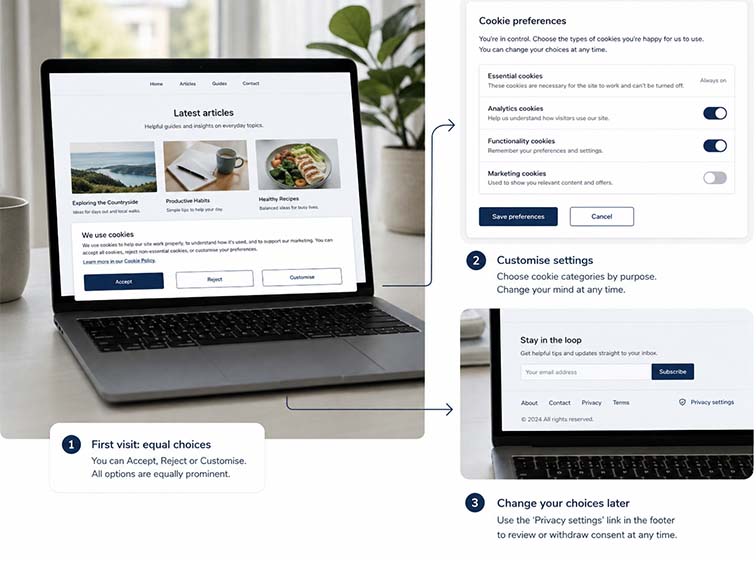
Optional storage or reading must remain inactive until the user gives a clear, positive choice. Continuing to browse does not provide valid permission. A preselected switch, silence, inactivity, or acceptance hidden within general terms also fails the required standard. Information must appear before the choice and describe each purpose with sufficient detail to support an informed decision.
- Block optional technologies before the relevant choice.
- Describe purposes through clear, accessible wording.
- Offer refusal as easily as acceptance.
- Provide separate controls for distinct purposes.
- Name third parties involved in the requested permission.
- Keep a route for later withdrawal or adjustment.
A consent interface should avoid pressure, misleading colours, obstructive routes, or unequal button prominence. The same control needs to work on smaller screens and common input methods. Any refusal must stop all non-exempt purposes within the rejected option. A visitor should not need to open several layers merely to decline the same set of uses. Consent records should preserve the selected purposes without treating later inactivity as agreement.
When Cookie Law Exceptions Apply
Five exceptions exist under the amended UK framework. Each remains narrow and purpose-specific. Mixed use defeats an exception where the same technology also supports promotion, profiling, cross-site recognition, or another non-exempt function. The assessment concerns the real operation rather than the category label chosen by a website.
| Exception | Required conditions | Website evidence |
|---|---|---|
| Communication | Sole purpose involves transmitting a communication. | Technical function must relate only to delivery over the network. |
| Strict necessity | Essential for a service expressly requested by the user. | The requested function would not operate without the storage or access. |
| Statistical purpose | Sole use involves service statistics under defined limits. | Clear information and a simple free objection route are required. |
| Appearance | Adapts presentation or functionality to a user preference. | Clear notice and an easy cost-free objection remain necessary. |
| Emergency assistance | Sole purpose identifies location to provide emergency help. | Use must remain limited to the emergency function. |
Advertising, affiliate measurement, and cross-site or cross-device tracking sit outside these exceptions. Security or statistics wording does not alter the result where another purpose also exists.
Site-level preferences and browser controls serve different roles. A website mechanism addresses purposes linked with one service and presents choices in context. Browser settings manage storage more broadly across selected domains or every visit. Device-level deletion also removes local values without necessarily changing a consent record held elsewhere. Using device controls does not remove the website’s duty to provide clear information, prior permission where needed, and an accessible withdrawal route.
Accept Reject and Customise Cookies
A compliant choice offers clear routes for all optional uses. The first layer should give equal access to acceptance and refusal, with a further path for purpose-by-purpose selection. Required functions remain separate from non-exempt categories. Explanations should identify what changes after each route, including whether an embedded feature stays unavailable or a preference prompt returns later.
- Accept: Choose the option covering every listed non-exempt purpose only after reviewing the explanation.
- Reject: Refuse optional storage and access without navigating through extra screens or confusing wording.
- Customise: Select individual purposes, save the decision, and leave unrelated switches off.
Statistical or appearance functions using an exception still need a simple, free objection method. A saved choice should reflect the chosen purposes rather than convert a refusal into later acceptance. Controls should remain reachable after the banner closes, using a persistent privacy link or equivalent route. Revisiting the page must not reset a valid refusal without a genuine reason.
Withdraw Consent and Delete Cookies
Consent remains reversible. Withdrawal should take no more effort than the original permission. Changing a preference stops future non-exempt use within the withdrawn choice. This step does not automatically remove every value held in browser storage or erase all records previously sent to another recipient. Those outcomes depend on the storage location, provider role, retention rule, and available deletion process.
- Reopen the website’s privacy or consent control where one is provided.
- Turn off the relevant optional purposes or reject all non-exempt uses.
- Save the revised selection and reload the affected page where needed.
- Clear remaining site data through browser settings when stored identifiers persist.
Earlier processing still falls under data protection duties. A deletion request, objection, or other privacy right follows a separate process where personal data exists. Contact [email protected] for a problem involving the site’s choice mechanism. Provide the page, browser, device, and approximate time so the issue is easier to reproduce without sharing sensitive casino account details.
Browser and Device Cookie Controls
Most browsers provide tools for viewing, removing, or restricting stored information. Names and menu locations vary by product, version, and device. Use the relevant help area for current instructions rather than relying on an old click path. Synchronised browsers might apply a change across several devices, while separate profiles often retain independent settings.
- Delete data stored by one selected website.
- Remove all cookies and local storage from the browser.
- Block third-party storage while retaining first-party functions.
- Clear selected information when the browser closes.
- Set site-specific permissions for storage, scripts, or tracking protection.
- Use private browsing to reduce retained local history after a session.
Blocking every item might remove saved preferences, repeat privacy prompts, or interrupt a chosen feature. Private mode does not prevent every form of recognition, network logging, fingerprinting, or server-side processing. A content blocker or tracking-protection feature also follows its own rules and might not match the choices shown on the service.
Data Processing and Third Parties
Storage and access rules focus on information placed on or read from terminal equipment. Data protection law also applies where a resulting record identifies, relates to, or singles out a person. Provider roles, purposes, recipients, transfers, retention, and security therefore need separate explanation alongside the device-level operation. Readers also need to know whether one organisation acts only on instructions or decides an independent purpose. A cookie name rarely shows the whole data flow. Referral parameters, scripts, and server requests might transmit information even after a local value expires.
Personal Data Uses and Retention
Relevant information might include online identifiers, IP data, browser details, device characteristics, page activity, referral parameters, consent choices, timestamps, approximate location, plus conversion records. A random code still falls within data protection law where it links activity to an identifiable or distinguishable individual.
Cookie expiry and server retention are not interchangeable. Removing a browser value ends local availability, yet a record previously transmitted might remain within a provider’s system for a separate period. Every use requires a defined retention rule based on necessity rather than convenience.
| Data category | Verified use | Retention rule |
|---|---|---|
| Consent choice | Records acceptance, refusal, objection, or selected purposes. | Keep only for the period needed to respect and demonstrate the choice. |
| Technical event | Supports a requested function, fault review, or limited security task. | Remove or aggregate once the operational purpose ends. |
| Referral event | Connects an outbound visit with attribution where activated. | Use the disclosed lifespan and separate server retention period. |
The entries explain retention principles rather than confirming a project-specific data flow.
Sharing Transfers and Security Safeguards
A third party might act on instructions for one defined service, decide its own purposes, or perform both roles across different activities. Clear disclosure needs the provider’s identity, service, information involved, location, onward recipients, and relevant control route.
| Provider | Role and information | Location and safeguards |
|---|---|---|
| Website service provider identified by name | Defined technical task using limited operational information | Processing location and contractual protections stated precisely |
| Independent analytics or advertising provider | Own or shared purpose involving identifiers and interaction data | Transfer route, recipient status, and applicable safeguard explained |
| Affiliate attribution provider | Referral or conversion record linked with an outbound journey | Destination, retention, access limits, and international treatment disclosed |
This format does not identify an active supplier. Security language should describe concrete measures such as access restriction, encryption in transit, logging, deletion controls, or contractual duties only where those protections are confirmed. No online transmission offers absolute protection. Appropriate safeguards reduce risk but do not remove it. Access should stay restricted to people and systems needing the information for the stated task, with deletion or aggregation following the stated retention schedule.
Cookies on Linked Casino Websites
NonGamStop Casino Sites publishes affiliate information and links to external gambling services. Once you open a linked casino, its operator controls its own website, account systems, consent interface, privacy terms, and storage technologies. A link does not establish shared ownership, common licensing, joint security, or equivalent legal standards.
- Read the destination’s privacy and cookie information before accepting optional uses.
- Review its consent controls separately from choices made on this domain.
- Keep casino account, payment, verification, and gambling data separate from editorial website contact messages.
- Consider whether a referral parameter or attribution method accompanies the outbound journey.
A referral relationship does not authorise this website to answer account, deposit, withdrawal, identity, bonus, self-exclusion, or complaint questions for an external operator. Your choices on one domain also do not automatically apply after a redirect. Review the destination before entering personal or payment information.
Policy Changes and Contact Details
Technology, provider, purpose, retention, sharing, and legal treatment change over time. A revised notice should remain aligned with the live implementation and current visitor controls. Material changes involving new non-exempt purposes, additional recipients, or altered controls require a fresh assessment and, where applicable, a new consent choice. Routine wording edits differ from technical changes. An accurate inventory should also remove retired technologies rather than preserve obsolete names, providers, or expiry periods.
Policy Review and Effective Date
An effective date gives readers a clear reference point for the displayed version. It should reflect formal publication rather than a guessed drafting date. An itemised inventory also needs review whenever a scan, configuration change, provider update, or new embedded feature alters the technologies operating on the service.
- A newly introduced storage or access method triggers review.
- A changed purpose requires fresh classification.
- A new recipient needs clear identification and data-flow assessment.
- A revised consent position requires updated controls and wording.
Minor language corrections differ from a material change. Fresh permission becomes relevant where an existing choice no longer covers the revised purpose or provider.
Questions Complaints and Correction Requests
Send a cookie-related question, correction request, or consent problem to [email protected]. Describe the issue without sharing a casino password, payment card number, cryptocurrency key, identity document, or unnecessary gambling account information.
- Provide the relevant page address.
- Name the device type used.
- State the browser and version where known.
- Give the approximate date of the event.
- Explain the observed behaviour and preferred correction.
This contact route covers NonGamStop Casino Sites. Questions about an external casino’s account, payments, verification, self-exclusion, bonuses, withdrawals, or operator-controlled tracking should go to the relevant destination. A message concerning personal data should describe the requested action clearly which helps route the issue appropriately. Keep a copy of the request and any relevant screen capture. Remove unrelated account numbers, financial records, identification files, or private keys before sending material by email. External operator complaints should go to the business controlling the relevant service.